
Global Impact in your language
Knowledge is empowerment. Understanding how Parkinson's affects the brain and body is the first step toward managing it with confidence, dignity, and hope.
Parkinson's Disease (PD) is a progressive neurological disorder that affects movement, balance, coordination, and many other aspects of daily life. It develops when nerve cells in a specific area of the brain, known as the substantia nigra, gradually lose their ability to produce dopamine—a chemical messenger essential for controlling smooth and coordinated muscle movements.
As dopamine levels decrease, communication between the brain and muscles becomes less effective, leading to changes in movement. While Parkinson's primarily affects movement, it can also influence sleep, mood, memory, speech, digestion, and overall well-being.
Parkinson's progresses differently for every individual. Some people experience mild symptoms for many years, while others notice more rapid changes. With early diagnosis, regular exercise, therapy, and appropriate care, many people lead active, fulfilling lives.
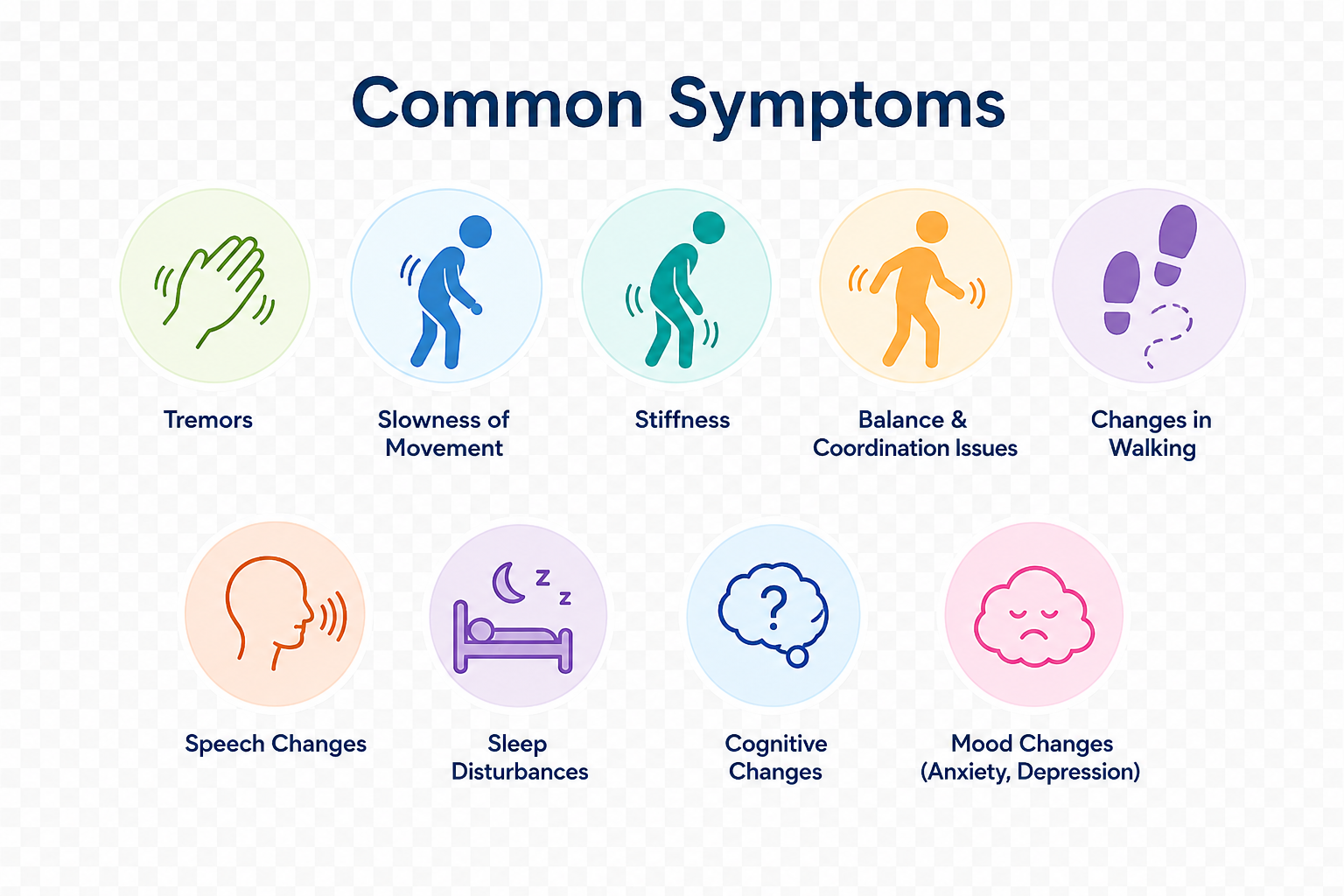
Understanding key symptoms helps patients and caregivers identify changes early and seek appropriate medical guidance.
A journey we understand. Support that makes a difference.

A new diagnosis can feel overwhelming, but taking informed, deliberate steps makes a significant difference in long-term wellness. PCC is here to guide you through finding the right movement disorder neurologist, establishing physiotherapy routines, and learning practical lifestyle adaptations.
While there is no single cure, combination treatments effectively manage symptoms and improve daily living.
Helps replace or mimic dopamine in the brain to significantly reduce tremor, stiffness, and slowness.
Physiotherapy, occupational therapy, and speech therapy build strength, balance, and vocal clarity.
Surgical option for suitable individuals when medication fluctuations occur. Learn more about DBS →
There is no single blood test or lab test for Parkinson's. A movement disorder neurologist conducts a thorough assessment.
Detailed evaluation of past health, family history, and onset of symptoms.
Assessment of muscle tone, reflexes, coordination, facial expressions, and fine motor skills.
Observing walking pace, arm swing balance, posture, and rest tremors.
MRI or specialized brain scans to rule out other conditions with similar symptoms.